
Audit Templates
When creating a new audit, you first need to select an audit template. Templates define which accessibility specifications will be used during the audit and provide a structured starting point for the evaluation.
Audit Lab offers predefined templates based on widely used accessibility standards, including WCAG 2.1, WCAG 2.2, their German adaptations, and BITV. Selecting the appropriate template ensures that the audit is aligned with the relevant regulatory or project-specific accessibility requirements.
To find the available templates or create your own, go to Audit lab (1) and navigate to the Audit templates tab. You can choose a template based on your project requirements from the available ones (2).
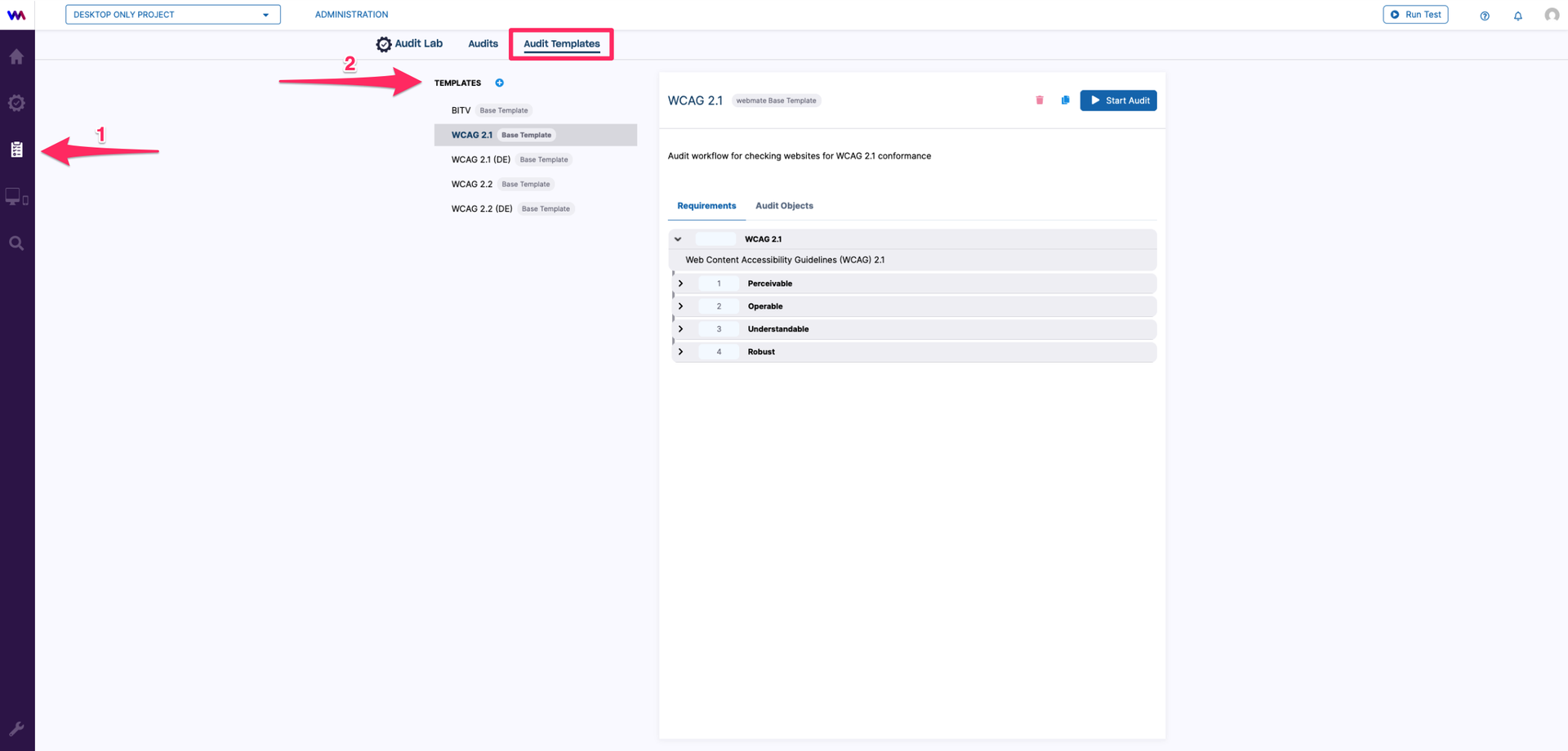
Each template is based on a specific accessibility standard or regulatory framework and defines the set of specifications that will be evaluated during the audit. The descriptions below outline the purpose of each template to help you select the one that best fits your project or compliance requirements.
WCAG 2.1
The WCAG 2.1 template is based on the Web Content Accessibility Guidelines (WCAG) 2.1, a W3C Recommendation that provides internationally recognized standards for accessible web content. The guidelines aim to make websites and digital applications usable for people with a wide range of disabilities, including visual, auditory, physical, speech, cognitive, and neurological impairments.
WCAG 2.1 is structured around four core accessibility principles: Perceivable, Operable, Understandable, and Robust (POUR). Under these principles, a set of testable success criteria defines how accessibility requirements can be evaluated. These criteria are organized into three conformance levels (A, AA, and AAA) that indicate the level of accessibility achieved.
Using the WCAG 2.1 template in Audit Lab allows you to assess your digital products against these standardized criteria, helping ensure compliance with widely adopted accessibility requirements and supporting the development of more inclusive and usable web experiences. This template is also available in German under the name WCAG 2.1 (DE).
WCAG 2.2
The WCAG 2.2 template builds on the WCAG 2.1 standard and includes all existing success criteria from WCAG 2.1, with several updates and additional requirements. WCAG 2.2 introduces nine new success criteria that further improve accessibility, particularly for users with cognitive disabilities, limited mobility, and users relying on keyboard navigation or touch input.
Compared to WCAG 2.1, WCAG 2.2 places additional focus on keyboard focus visibility, target size for interactive elements, accessible authentication, consistent help mechanisms, and reducing redundant user input. These improvements aim to make digital interfaces easier to navigate and interact with across different devices and input methods. One older criterion (4.1.1 Parsing) has also been removed because it is now considered obsolete.
Using the WCAG 2.2 template in Audit Lab allows you to evaluate accessibility according to the latest version of the WCAG 2 standard, ensuring that audits reflect the most current guidance and accessibility expectations. The template is also available in German (WCAG 2.2 (DE)).
BITV
The BITV template is based on the Barrierefreie Informationstechnik-Verordnung (BITV), Germany’s regulation for accessible information technology. BITV defines how digital accessibility requirements under the German Disability Equality Act (BGG) should be implemented for public-sector websites and mobile applications. It is the primary legal framework used to evaluate the accessibility of digital services provided by German federal, state, and local government bodies.
BITV aligns with the European accessibility standard EN 301 549, which incorporates WCAG 2.1 Level AA as the baseline accessibility requirement. In addition to the WCAG criteria, BITV includes specific requirements for the German public sector, such as providing an accessibility statement, offering feedback mechanisms for reporting accessibility issues, and ensuring key information is available in German Sign Language and Easy Language.
Using the BITV template in Audit Lab enables you to evaluate digital products according to the German legal accessibility requirements, helping organizations that operate in or provide services to the German public sector ensure compliance with national and European accessibility regulations.